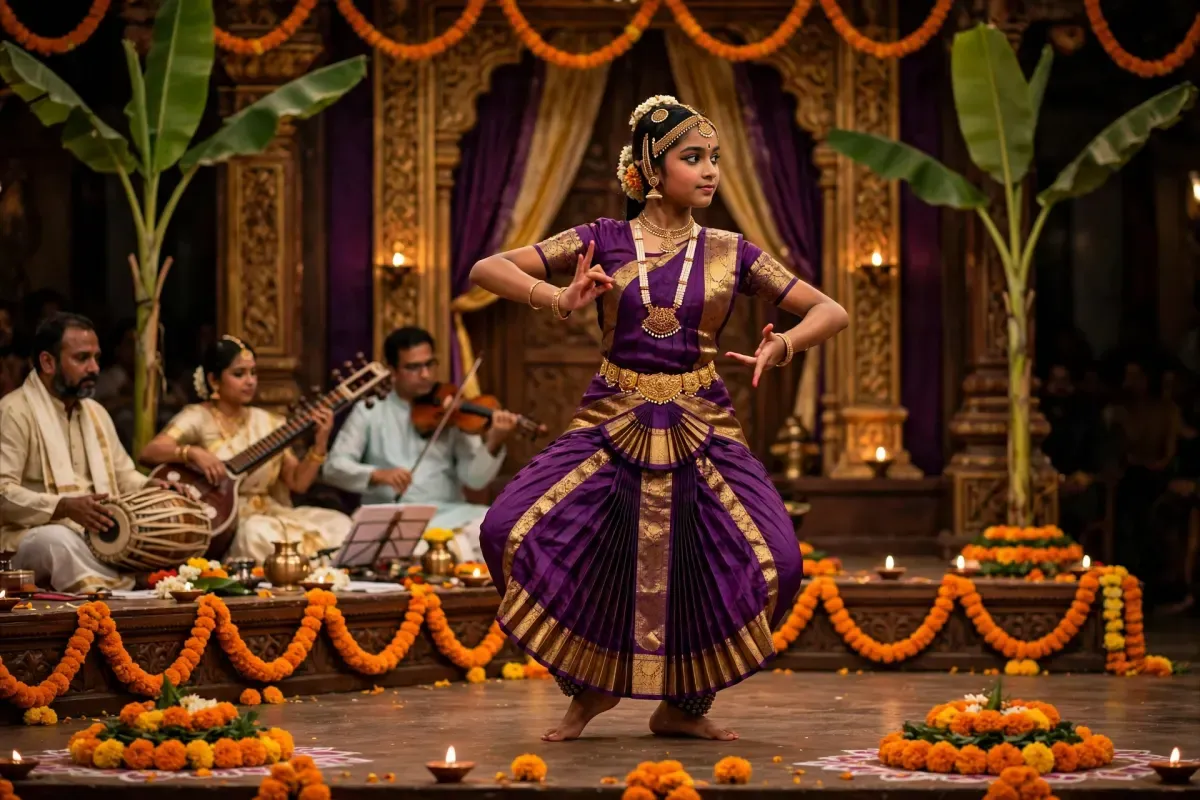
The word Arangetram comes from Tamil: arangam, the stage, and etram, ascending. It is the moment a student ascends the stage alone for the first time as a complete performer — typically around two hours of full classical repertoire, danced with live musicians, in full costume and jewellery, before an audience of family, friends and the wider community.
It is best understood as a graduation. Just as a music student might sit a final recital examination, the Arangetram dancer presents the complete margam — the traditional sequence from alarippu through varnam to tillana — demonstrating technique, stamina, rhythm and, above all, abhinaya: the expressive storytelling that separates a performer from a student.
Readiness is the Guru’s call, and it is not only about steps. At our school, a student is invited into Arangetram Preparation when their technique is secure, their varnam can hold an audience for thirty minutes, and — this matters most — they have the maturity to rehearse seriously for six to nine months. Most students reach that point after six to eight years of consistent training. There is no fixed age, and rushing helps no one: an Arangetram should be a triumph, not an endurance test.
For families, the honest conversation includes cost and effort. Beyond preparation classes, there are musicians, theatre hire, costume, invitations and catering to plan. Schools should give you a clear, itemised picture early — ask for it. What families consistently tell us afterwards, though, is that the day becomes a landmark: grandparents flying in, a teenager standing tall in her heritage, a confidence that carries into every interview and presentation afterwards.
If your child is a few years into training, start the conversation early and casually. Watch an Arangetram together — most schools welcome prospective families — and let your child see what the summit looks like. The path is long, but it is walked one adavu at a time, and every great Arangetram began with a five-year-old in a practice saree, learning to bend her knees and smile at the same time.