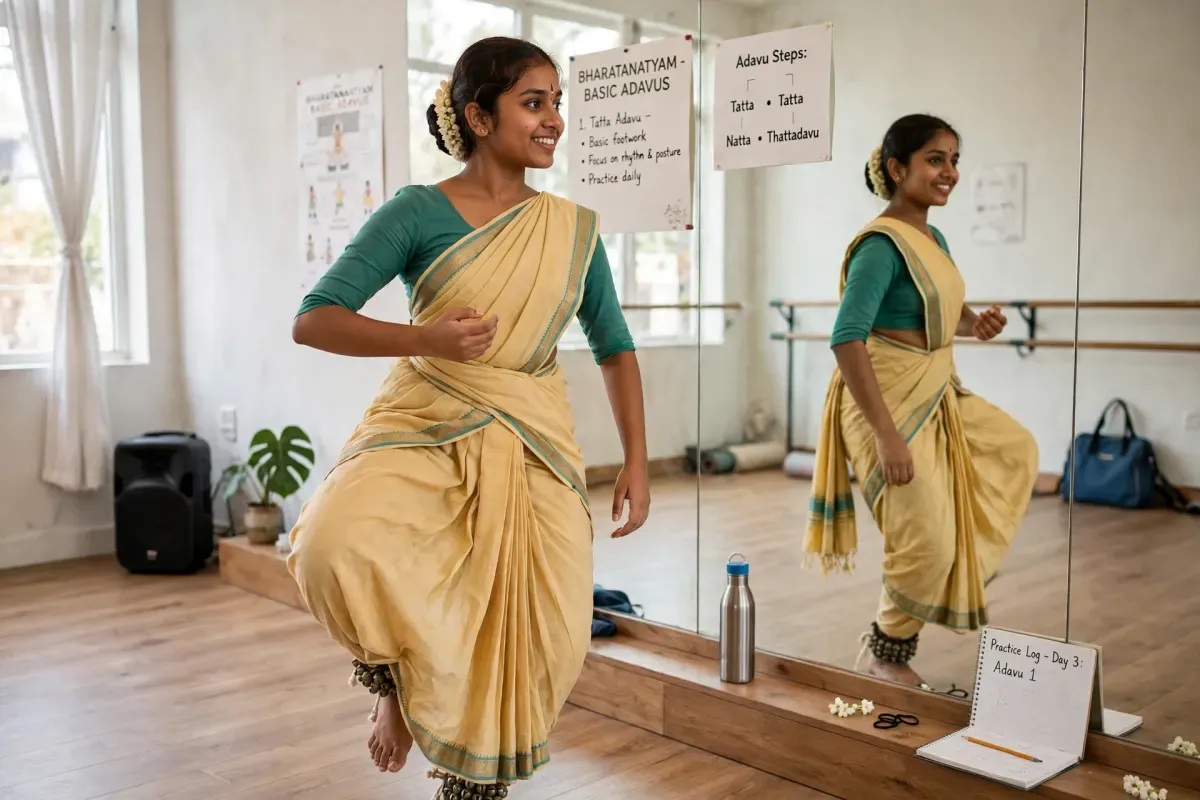
Every Bharatanatyam journey starts the same way: standing in araimandi, knees bent and turned out, wondering how something that looks so graceful can make your thighs burn. That burn is famous — and temporary. Within a few weeks, the posture that felt impossible becomes the place your body goes without thinking. That is the quiet magic of a well-taught first term: nothing is rushed, and everything builds.
The first thing beginners learn is not a dance at all. It is the language. Adavus are the basic step units — the alphabet of the form — and each one combines feet, arms, eyes and head in a set pattern. Students also meet the mudras, the hand gestures that will later become words: kataka, alapadma, pataka. In class we teach them with stories, because a five-year-old remembers “the lotus opening” far better than a Sanskrit list.
Rhythm arrives early too. Bharatanatyam is danced to tala, a repeating cycle of beats, and beginners clap, count and step to sollukattu — spoken rhythm syllables — long before they dance to recorded music. Parents are often surprised at how quickly children internalise complex rhythms when they are taught through the body first and theory second.
By the end of the first term, a Foundation student can hold araimandi with correct alignment, perform the first sets of adavus in three speeds, name and show the single-hand mudras, and perform a short alarippu-style opening sequence. Just as importantly, they know the classroom culture: how to greet the Guru, how to tie ghungroo, how to practise ten minutes a day without it becoming a battle at home.
If you are choosing a school, ask to see the level structure. A good school can tell you exactly what Foundation, Intermediate and Advanced each contain, and what an Arangetram requires years down the track. Dance training is a long road — it should be a mapped one. And if your child comes home from the trial class demonstrating a mudra at the dinner table, that is the oldest sign in the world that the journey has begun.