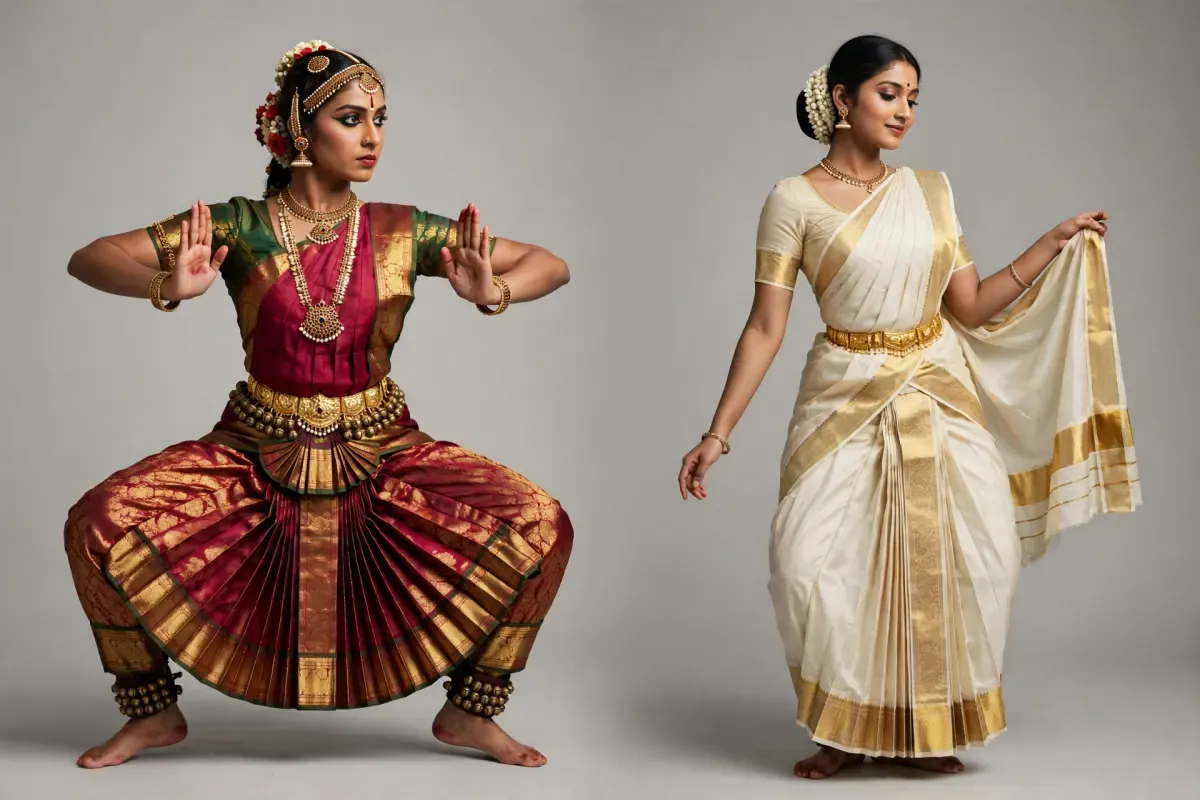
Parents often ask us which form is “better” — Bharatanatyam or Mohiniyattam. It is the wrong question, and we say so kindly. These are two complete classical languages with different personalities. The right question is: which language will your child love speaking for the next ten years?
Bharatanatyam, from Tamil Nadu, is architecture in motion. The araimandi posture is deep and grounded, the movements are geometric, the footwork is percussive and precise. Children who love structure, maths-like rhythm and a satisfying physical challenge often thrive here. It is also the most physically demanding of the two at the start — those first months of araimandi build serious leg strength.
Mohiniyattam, from Kerala, is water in motion. The torso sways in continuous, rolling curves; the steps are soft; the expression is subtle and lyrical rather than dramatic. It tends to suit older children, teens and adults, and students drawn to music, poetry and nuance. Do not mistake gentle for easy — sustaining that fluid control for a full varnam requires deep core strength and patience.
Practical differences matter too. Bharatanatyam classes here start from age five; Mohiniyattam from eight, because its control develops best in slightly older bodies. Costumes differ — the pleated silk fan of Bharatanatyam versus the white-and-gold kasavu of Mohiniyattam — and so does the music: Carnatic compositions in Tamil and Telugu for one, Malayalam sopana-inflected pieces for the other.
Our honest advice: watch both. Bring your child to a trial class in each form, and watch their face, not their feet. Children choose with their whole bodies — one form will make them lean forward. That lean is worth more than any comparison chart, including this one. And remember, many of our senior students eventually study both. The forms are different languages, and bilingual dancers are richer for it.